

Nano Banana 2.1 Pricing: 1K, 2K, 4K, and Batch Costs
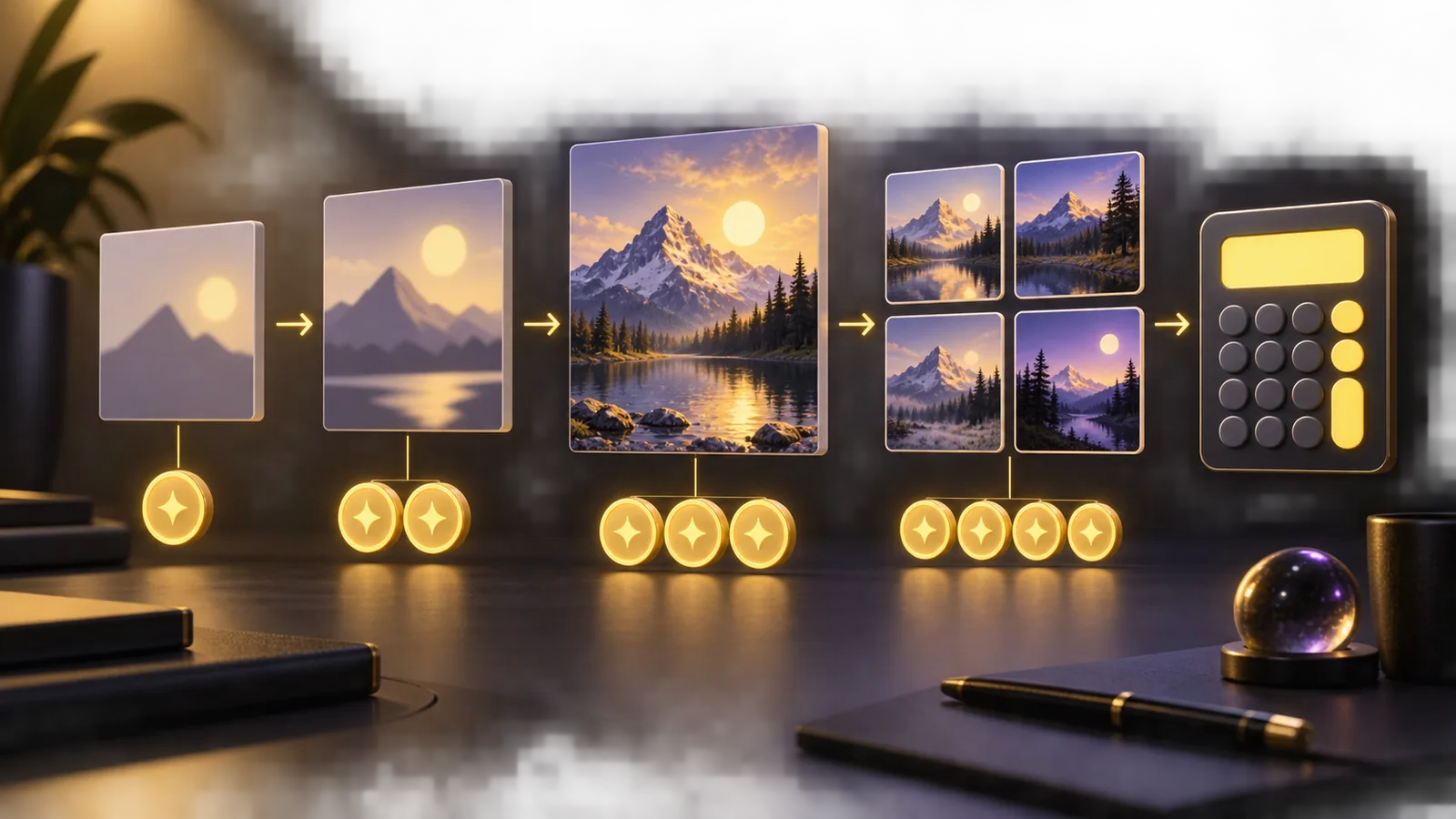
Nano Banana 2.1 costs 2 credits for each 1K output, 4 credits for each 2K output, and 6 credits for each 4K output on nanobanana21.net. If you request a batch, multiply that amount by the number of outputs. Four 4K images therefore cost 24 credits.
Check the current editor settings and cost
The short answer
| Resolution | Credits per output | Four-output batch | Best starting use |
|---|---|---|---|
| 1K | 2 | 8 | Prompt and composition exploration |
| 2K | 4 | 16 | Normal publishing and closer review |
| 4K | 6 | 24 | Approved final direction and larger placement |
The site calculates the total before submission. The formula is:
Total credits = credits per output × number of outputs
This article covers the Nano Banana 2.1 option in our editor. Other models and supporting tools have their own costs.
Why 1K is usually the cheapest first step
AI image cost is not only the price of the accepted image. It includes discarded variations and retries. Starting every rough idea at 4K spends credits on pixels before you know whether the composition works.
A more efficient sequence is:
- Generate one or two 1K outputs to validate the idea.
- Correct the highest-impact problem: subject, composition, reference role, or wording.
- Generate a 2K version when you need to inspect small details.
- Move to 4K only after the direction is usable.
For example, one 1K draft, one revised 1K draft, and one final 4K output cost 10 credits in total. Beginning with a four-image 4K batch would cost 24 credits before any revision.
When a batch saves time
A batch is useful when you want multiple creative directions from one stable brief. Good cases include:
- four layout ideas for the same campaign;
- several lighting treatments for one product;
- multiple thumbnail concepts;
- alternate poses where exact continuity is not essential.
A batch is less useful when you already know what is wrong. If the label is misspelled, the face changed, or a reference was ignored, four identical retries can repeat the same problem. Revise the instruction first, then request one result.
How to estimate the cost of a finished asset
Use accepted output cost instead of advertised single-run cost:
Effective cost per accepted image = all credits used for the task ÷ accepted outputs
Suppose a product hero takes two 1K drafts, one 2K review image, and one 4K final:
| Stage | Outputs | Credit calculation | Credits |
|---|---|---|---|
| Composition draft | 1 × 1K | 1 × 2 | 2 |
| Preservation revision | 1 × 1K | 1 × 2 | 2 |
| Detail check | 1 × 2K | 1 × 4 | 4 |
| Final render | 1 × 4K | 1 × 6 | 6 |
| Total | 4 generated, 1 accepted | 14 |
The final image did not “cost 6 credits” in production terms. The task cost 14 credits. Recording this number helps teams compare workflows honestly.
Subscription credits and one-time credits
At the time of this review, nanobanana21.net offers monthly plans and one-time credit packs. Monthly plan credits refresh with the billing period. One-time packs are described on the pricing section as valid for 365 days. Prices and purchase terms can change, so check the live pricing section before buying.
Avoid estimating image count from a single generic “credits per image” statement. Resolution and batch size change the answer. A 500-credit balance could fund up to 250 single 1K outputs, 125 single 2K outputs, or about 83 single 4K outputs if every submission completed at that setting and no credits were used on other tools.
What happens when a task fails?
The site reserves the required credits when it creates a generation task. A confirmed successful task consumes that reservation, while a confirmed failed task supports an automatic credit refund. A pending task or a temporary status-check error is not yet a confirmed failure. If your balance does not match the completed and failed results shown in your account, keep the task identifier and contact support through the site's contact route so the transaction can be reviewed.
Do not repeatedly press Generate while a task is still processing. That can create additional requests rather than speeding up the original one. First check the task status or generation history.
1K vs 2K vs 4K by destination
Social concepts and thumbnails
Start at 1K. The composition matters more than native 4K during exploration.
Blog illustrations and presentations
Use 1K for the draft and 2K for an approved visual when readers may open it larger.
Ecommerce product imagery
Start at 1K to test the scene. Use 2K to review label and edge quality. Request 4K only after product shape, color, and branding are acceptable. Our product photography guide includes a quality-control checklist.
Posters and images containing text
Higher resolution helps inspection, but it does not guarantee correct words. Keep copy short, quote exact text in the prompt, and verify every character. If the wording is mandatory, add final typography in a design tool.
Reduce retries before reducing resolution
The biggest cost leak is often an unclear brief. Before generating, state:
- the primary deliverable;
- which reference controls identity or product appearance;
- what may change;
- what must stay unchanged;
- the destination and aspect ratio;
- the exact text, if any.
Our prompt guide provides reusable structures. For multi-image input, use the reference-image workflow.
Frequently asked questions
How much does one Nano Banana 2.1 image cost here?
It depends on resolution: 2 credits at 1K, 4 at 2K, or 6 at 4K, checked October 15, 2026.
How much does a four-image batch cost?
It costs 8 credits at 1K, 16 at 2K, or 24 at 4K.
Does a higher resolution improve prompt accuracy?
It mainly requests a larger output. It cannot guarantee correct identity, spelling, layout, or object count.
Should I generate four variations at once?
Use a batch when you want breadth. Generate one at a time when you are diagnosing a specific error.
Are website credits the same as Google API tokens?
No. Credits are the website's retail usage unit. Google and KIE publish separate API billing and request rules.
Last checked October 15, 2026. Always review the displayed total immediately before submitting because site costs and plan terms may change.